Hyper literalism and the eagle that eats your liver
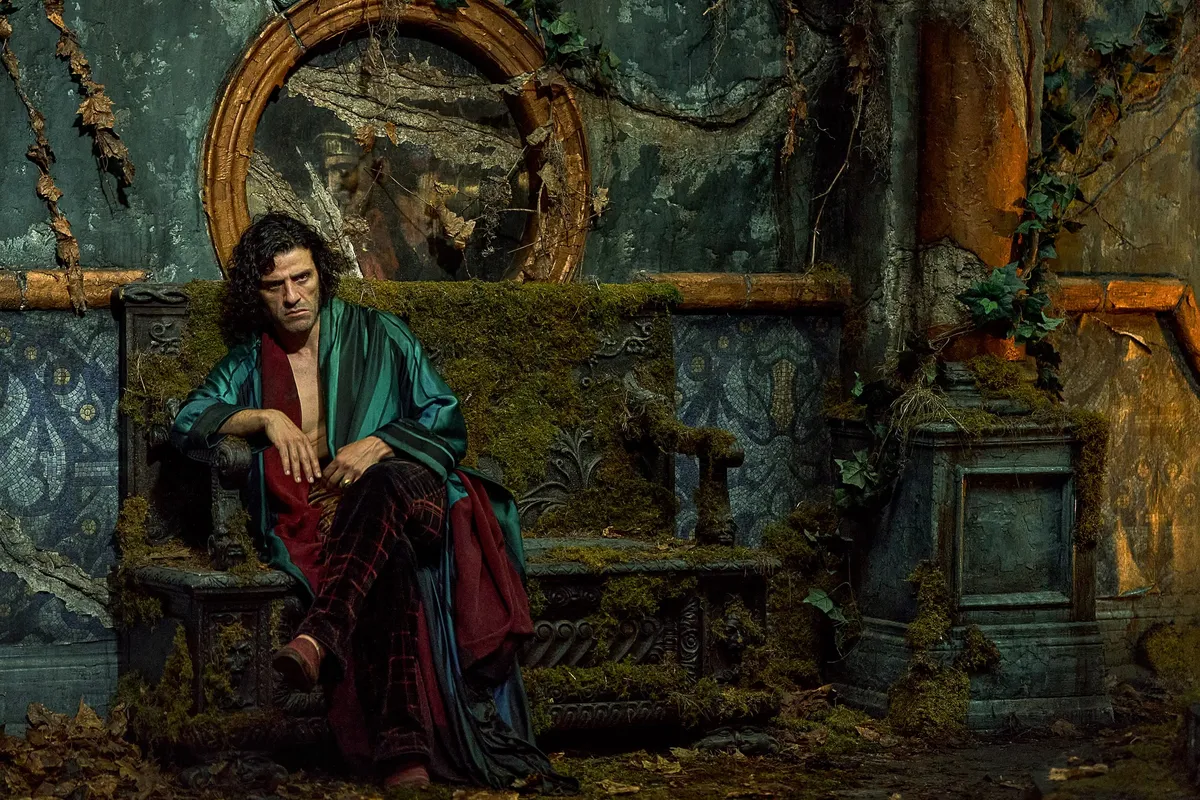
Currently watching GDT’s Frankenstein and struck by two warring factions in my brain: this movie has spectacularly beautiful production design and a completely insufferable script.
Okay, I’m being a little uncharitable. But this movie has a lot to live up to: a renowned director adapting the novel that birthed science fiction, which is also one of the most well known pieces of English literature possibly ever. I admittedly went in a little biased, with some friends asking me if I’d seen it as they wanted to hear my thoughts on the script and dialogue, so I kind of had my expectations lowered right off the bat.
But I’m also in the process of working on a personal project, which is what inspired this post. I’m working on a visual novel that, without revealing too much, has me researching gnosticism and alchemy. I’m currently (as of last night til like 2 am, oops) reading Newton, the Alchemist: Science, Enigma, and the Quest for Nature’s “Secret Fire” by William R. Newman, which is a comprehensive text on Isaac Newton’s studies and writings on alchemy (or as it’s frequently referred to in the book “chymistry,” the field of study that bridges archaic alchemy and esoterica with modern chemistry as we know it). I’ve also been reading some of Newton’s own writings directly via The Newton Project, an online catalog of Newton’s writings.
The Secret Fire
Alchemy is not a legitimate field of study or science. Much of Newton’s posthumous biographies intentionally leave out his work on the subject, with his alchemical writings being reduced to “poetry” as compared to his more legitimate work in the fields of reason. And part of the reason for that characterization is the deliberate obfuscatory and allegorical nature of the writings that make up the fields of alchemy and chymistry, Newton’s writings included. Gnosticism, which shares much of the same spiritual and philosophical DNA as alchemy, is also characterized by esoterica and improvable knowledge that is discovered via self realization. Much of the surviving texts we have in these fields are difficult to truly understand, because practitioners deliberately did not write the literal definitions of their findings and beliefs. Their knowledge was carefully guarded and intentionally hidden.
Anyway, I am by no means an expert on any of this. I am almost certainly generalizing things, if not outright mischaracterizing others. But this is my takeaway after a good few months of research for my personal project, which at my vaguest description involves a story about the creation of life and the ego of a practitioner of esoterica. I consider the original Frankenstein novel to be a touchstone for my project. I was hoping for the film to serve as an additional touchstone, as an exploration and adaptation of the original story and its themes from a modern perspective. But as I am watching it (just past the halfway point, at the time of me typing this first draft) I am repeatedly struck by how overly literal the film is. And this is especially jarring in contrast to the esotericism of alchemy as I have come to learn about it.
Gnosticism and alchemy are both highly egotistical. Practitioners gate kept their knowledge and believed themselves to be integral to their experiments; even if one could successfully glean knowledge from their notes, they had to be the “right kind of person” to properly recreate the work to its desired effects. The ‘gnosis’ or knowledge of gnosticism is about a divine knowledge that is only discoverable through the self, not through being taught by others. That leads54r8irj [Onion’s revisions] That leads to the gnostic field of knowledge to be highly subjective and vary on an individual level, which doesn’t lend itself well to empirical methodologies. So it’s no wonder that gnosticism has not really survived to the modern day.
None of this is necessarily relevant to the original Frankenstein novel but it is relevant to my point, so bear with me while I get there.
Frankenstein
By now, most people are probably familiar with the gist of the original story. But not as many people might know about the context that led to its creation or informed its writing. Much of the narrative is born from Mary Shelley’s own lived tragedies, from the suicide of her sister to the deaths of her infant children. There is much to be said about the grief of parents and children, of guilt and loss. But the story is rich for interpretation across many different themes; the gendered elements of motherhood and the creation of life, the political and philosophical elements about power and who wields it, and in the 200+ years since its publication there have been many adaptations exploring and adding many new themes utilizing the archetypes introduced of creator and creature. All this is to say that I am not expecting the film to be a perfect recreation of the original novel; my problems with it lie less in the thematic content and more in the dramatic and written execution.
Around the early halfway point of the film, the character Herr Harlander (an iteration of the Igor lab assistant archetype absent from the original novel but frequent in subsequent film adaptations) begs Victor for a second chance at life through Victor’s experiments to master death. In their ensuing fight, Harlander proclaims himself to be “the eagle that will eat [Victor’s] liver,” referencing of course the myth of Prometheus that the original novel borrows for its namesake (the full title being Frankenstein, or the Modern Prometheus). But what the hell does that actually mean, here? The eagle that eats Prometheus’ liver in the myth is a punishment decided upon by the gods to be afflicted upon Prometheus for his daring to share the gift of fire with humankind. But Mary Shelley’s allusions to Prometheus in her novel are less about him as a sympathetic trickster who is unjustly punished for the favor he bestowed upon humans, but about the version of him as the creator of mankind as written in Roman antiquity, who molded man from clay.
Pause. I just got the Ozymandias quote. Are you fucking kidding me?
Anyway. It can be argued that there’s a through-line in the gift of fire enabling mankind to flourish and the Creature’s life being jumpstarted by a bolt of lightning, both fire and lightning being the property of the gods that man cannot claim ownership of but yet still learn to channel. But I don’t feel inclined to read Harlander’s line that way. Once he dies, he is absent from the film; hardly the divine punishment upon Prometheus or Victor that he proclaimed himself to be. I don’t think it’s an allegorical line at all, instead referencing in broad strokes the popular understanding of the myth that Mary Shelley incorporates into her novel, regardless of whether or not it’s the same version of that myth at all.
It strikes me as possibly the one line in the film that doesn’t speak to GDT’s thematic intentions, which is what makes the line stand out to me. The rest of the characters frequently speak of life and death, of God and the divinity of creation, of loneliness and suffering and the definition of what makes one human. Which sounds fine, except that it is literally every single line, and no line is left vague in its delivery about what the theme of the movie is. And that’s the crux of my issue with the film: it beats you over the head with its intentions, its characters mouthpieces rather than the living organisms in the ecosystem of its story. And that’s not a unique problem for this film, or for film at all.
Hyper Literalism
We are in an era of hyper-literal stories that do not have any faith in their audiences’ abilities to chew and digest a story in hope of divining its meaning. Creators are so fearful of being misunderstood and mischaracterized in intention that they opt to write more literally, attempting to eliminate any chance of room for doubt and eliminating nuance in the same breath. Now compare this to the hyper individual knowledge keeping of alchemy and Gnosticism; practitioners intentionally made their writings more obtuse and allegorical, to keep people from understanding them for fear of their individual knowledge no longer being unique to them. Today’s information is more accessible, “democratized” even as some AI pundits might say, but individual readings and interpretations of stories have fallen to the wayside in favor of people trying to deduct the “true” meaning of a story. And in response to audiences treating stories like puzzles to solve rather than experiences to interpret, creators don’t want to risk the chance of misinterpretation at all.
I mentioned this briefly in my last blog post about nouns I verbed in 2025, but I saw the theatrical rerelease of Angel’s Egg in November. As soon as credits rolled and the lights went on, the man next to me turned to his girlfriend and loudly proclaimed that he didn’t understand the movie at all. And that doesn’t surprise me; no one can ever accuse Angel’s Egg of being hyper-literal. I don’t think anyone could call its writing literal at all. And after years of being fed a diet only of overly explained stories and Wikipedia summaries and short-form video, I doubt most moviegoers are equipped to deal with the levels of ambiguity and open-ended-ness that a film like Angel’s Egg is made of. And if that’s true of cinema audiences, what does that mean for the audience of video games, a medium whose industry is constantly at war with itself to create more movie-like experiences?
Here’s an anecdote. When my coworkers on the narrative team at KO_OP and I were first drafting out an initial storyline for Young Suns, we structured it in such a way that the three of us (myself, Kevin, and Marty) would each write one character’s quest, and then we would have a conclusion quest that tied the storyline together. Kevin, our lead, wrote the conclusion quest. When they finished the first draft and Marty and I took a look at it, we were struck by some sort of dissonance that we couldn’t put our fingers on. The conclusion quest’s final scene was poignant and beautifully written, but left a lot of things unsaid. At first, we thought that meant that we should change the conclusion quest. But looking at the storyline together as a whole, we eventually came to the conclusion that we had written the individual character quests to be too literal and tell, not show.
A lot of writing advice that’s parroted and emphasized in books, especially for screenwriters, is “show, don’t tell.” But a lot of that advice was written before the advent of social media and of TikTok. That’s not to say that social media murdered media literacy with its bare hands. But now that we live in an age of information, we are too used to the convenience of just looking something up in a search engine to understand it. Sparknotes and similar websites exist to give shortcuts on literature that’s commonly assigned for English classes, ostensibly to help people study but mostly just resulting in the memorization of facts to be parroted rather than an internalization and digestion of the subject matter. AI tooling on Kindle and (etc) offer to read books for you, providing summaries of plot events as you are reading them from the page. Stories are not emotional experiences we take in and are changed by, they are compilations of facts to be memorized and regurgitated, from the events of a plot to the message and intention of its theming. And a story that does not literally tell you its meaning, a story that leaves things unsaid, is met with frustration and antipathy.
But muscles never get stronger if we never use them; if we never submit ourselves to ambiguity and the individual work of interpretation, how will we learn to tell stories ourselves? Better yet, how will we learn to interact with a world that isn’t authored, that doesn’t have some grand meaning or intent behind the events that happen to us? We need to learn to make our own meanings from things, be they fiction or real life. We will not learn to do that by reading Wikipedia-esque summaries on what “actually” happened.
I understand GDT’s Frankenstein all too well. I understand the Oedipal intention of casting Mia Goth both as Victor’s mother and as the bride of his brother and object of his lusts. I understand the deliberate parallels between the cruelty of Victor’s father towards him and Victor’s cruelty towards the creature. I understand that Victor is the monster, because his brother tells him (and the audience) that he is with his dying breath. I understand that the Creature forgives Victor, because he tells him so. And I really hate to be told these things when I am in the practice of storytelling. I want to sit down and savor the story being told to me as the food for thought that it is, rather than the sickly sweet syrup that goes down too easily and leaves me with nothing but an artificial taste in my mouth. I want to be taken seriously and respected by the stories I experience. And I am relearning how to treat my audiences (ha) the same way.
One of my biggest grievances with my own writing for Goodbye Volcano High is that it was too literal and not subtle enough. But I wasn’t on that project from its conception; I was a fixer, brought on in the end stages of the project’s life. I had to fix what I could, where I could in the year and 4 months that I worked on it. There wasn’t much of an editorial process at all by that point. So working on Young Suns has taught me many things, chief among them a reeducation in subtlety and subtext. I have to stop using the yellow paint to point players in my direction, and instead hold out my hand and hope that they will take a chance to learn the story of Young Suns through play and discovery rather than being spoon-fed. It’s a leap of faith, but it’s one worth taking.
Onion Tax
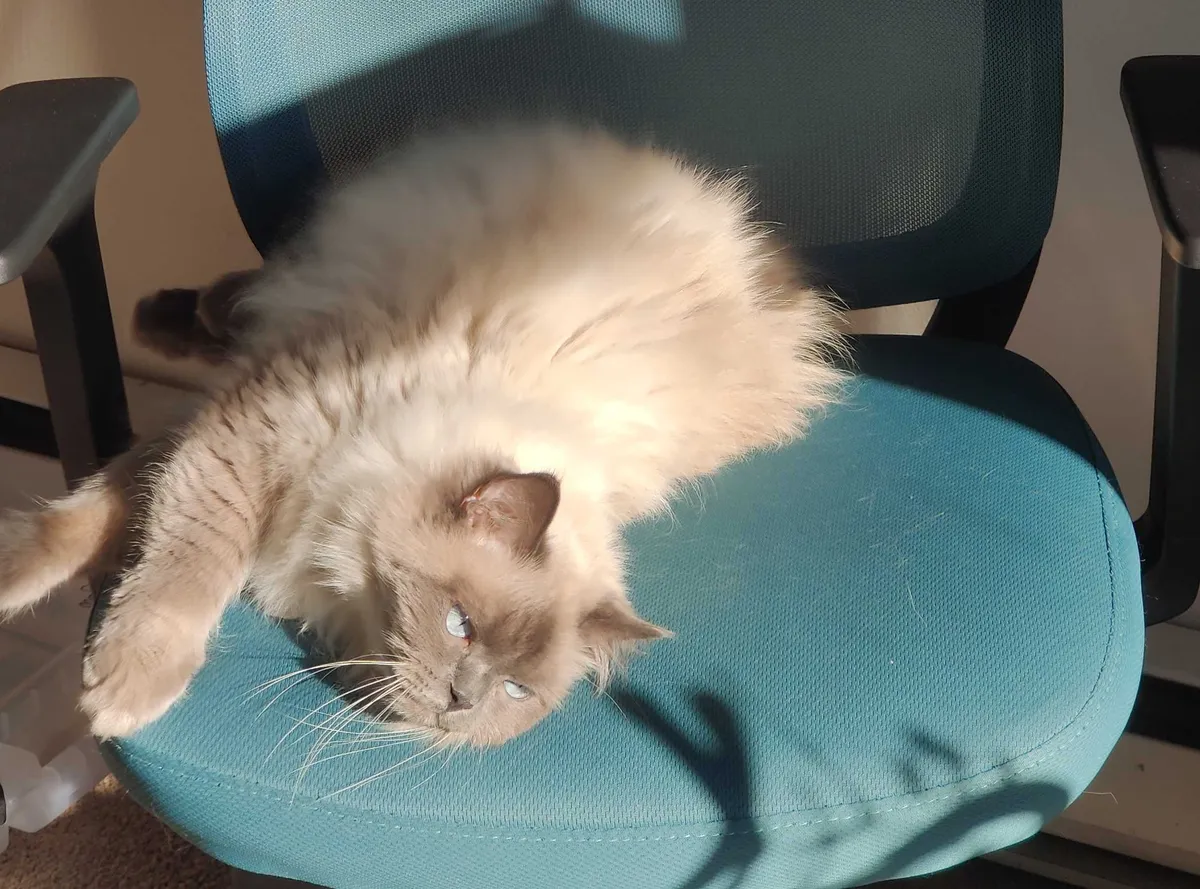
If you made it to the end, thanks. Here’s my shit son. He walked on my keyboard during this so I chose to immortalize his contributions. He has really enjoyed sitting at my desk chair these days, like a vizier sitting on the king’s throne when the king isn’t in the room to see.
I do still want to do blog posts on Young Suns, but Marty and I are in the process of submitting a talk on Young Suns to Narrascope! So I’m holding off in the interest of seeing if it gets accepted, and then going from there.