The Cozy Grind
Or, my thoughts on some recent(ish) life sims that I've played.
So, I obviously have a lot of thoughts on writing for life sims as someone who's been working on one for over 3 years. But I also have thoughts on them as someone who's played them for a long time. Stardew Valley was a favorite of mine for many years, a comforting routine that I could fall back into when I needed the dopamine hit of feeling accomplished and in control of my life during times I felt untethered and depressed. For all that game narrative is my bread and butter, Stardew is one of the few games I never really played for its writing. To be clear: I love romance in games, but the romance options in Stardew lack depth and meaning to me. Marrying someone in Stardew was more about creating the idea of a romance and decorating a house that told a love story matching my selected love interest rather than an actual emotional experience that moved me.
But for all that Stardew's writing isn't great, it at least has tension and stakes for most of its characters. Even the nicest characters in Stardew are wary of you at first, and you can't enter anyone's bedrooms until you're at least friends with them. Which is a significant difference from the unlimited player freedom of a lot of other games! Even if the characters' dialogue wasn't particularly interesting, there was an actual sense of growing closeness in learning a characters routines and likes and dislikes. Whether or not you learned that from the Wiki or from playing might change that slightly, but even knowing the best gifts to give a character doesn't change how they regard you warily at the beginning of a game. This is where I'll bring up Fields of Mistria as a comparison.
Game Dev Yells At Cloud
Fields of Mistria is a lovely little game. The music, visuals, and gameplay are all significant improvements upon the Stardew formula. But they are following the formula. The tool bar, the basic game flow, all of it is essentially Stardew with a fresh coat of nostalgic 90s anime paint. And I don't begrudge that! I've never really been a modder, so being able to play something comfortingly familiar in a newer, more polished context was an instant draw for me. I've also been a longtime fan of the Johnny Wander comics duo Ananth Hirsh and Yuko Ota, who worked on the game as senior writer and character concept artist respectively, and learned about the game through following them for many years.
I've been playing it in Early Access since it launched, picking it back up with major content updates and dropping it when I exhaust everything that's new. With Mistria entering 1.0 last month, I decided to start a fresh save to see all the content that's been added for seasons I've already passed once to get a better idea of what early game progression looks like. And going from a fairly late-game save, even one for an earlier version of the game, back to the beginning has really struck me with how little actually changes for the town of Mistria even after several in-game months (or years!) of progress.
The primary high stakes progression of Mistria is centered around raising the town's rank, something abstractly meant to represent the town's recovery from a major earthquake prior to the game's events. As the town rank is increased, major story quests are given that revolve around repairing or upgrading infrastructure in and around the town. The infrastructure ranges from bridges to the windmill to the various shops and institutions around the town. And while the characters will acknowledge the changes through dialogue... that's kind of it?
Most of the benefit from these activities is not the act of service for your community; instead it is a widened variety of products and services available to the player, all of which can be completed without ever interacting with the characters at all. You can grind flour in a mill by yourself for hours; you never see the other farmer there doing the same. You can access all shops at any hour of the day and purchase whatever you need without the slightest friction of interacting with someone working the register. Which isn't unusual for a video game, but for a farming sim to slowly eliminate every element of friction for the player it leaves an odd taste in my mouth.
Capitalism encourages and cultivates a culture of alienation and distance from everyone. Take grocery stores for example-- we've seen an increase in self-checkout aisles and a decrease in employees working the register. We allow capitalism to hook us on convenience, and we're told that interacting with other people is an inconvenience that can be easily avoided. At first blush, that's an odd feeling to encounter in a "cozy" game. But coziness is often equated with comfort, and interacting with people means opening yourself to the risk of _dis_comfort. After all, what's cozier than staying in your own little bubble of comfort? Certainly not having an awkward interaction with a stranger ringing you up for your menstrual products. But without discomfort, without friction, our lives have no texture.
The further I get into Mistria, the less friction there is. Sure, I could choose NOT to acquire all the skills that make my crafting time faster and my cooking more efficient. But the game does not encourage or reward me for that. And having more time on my hands from those quality of life skills leaves me aimless; there simply isn't enough to do beyond your own solipsistic grinds-- populating the museum collection, digging deeper into the mines, raising your animals. None of that takes me to the game's strongest aspect, which is its characters and writing. And if I DID take the time to find and talk to a character, I never really learned any of their schedules. I could just open the town map and see where everyone is at any point in the day; paired with the fact that there were essentially no rooms or houses off limit to me, no character was ever safe from me barging into their space. If I needed to know what gifts to give them, I had easy access to an in-game list of their preferences. I was pleasantly surprised when I'd have a birthday in the game or would randomly receive a gift from talking to an NPC, because they were the only times that it felt like the transactional nature of the gift-giving relationship progression was a two-way street. But that is an incredibly low bar to clear.
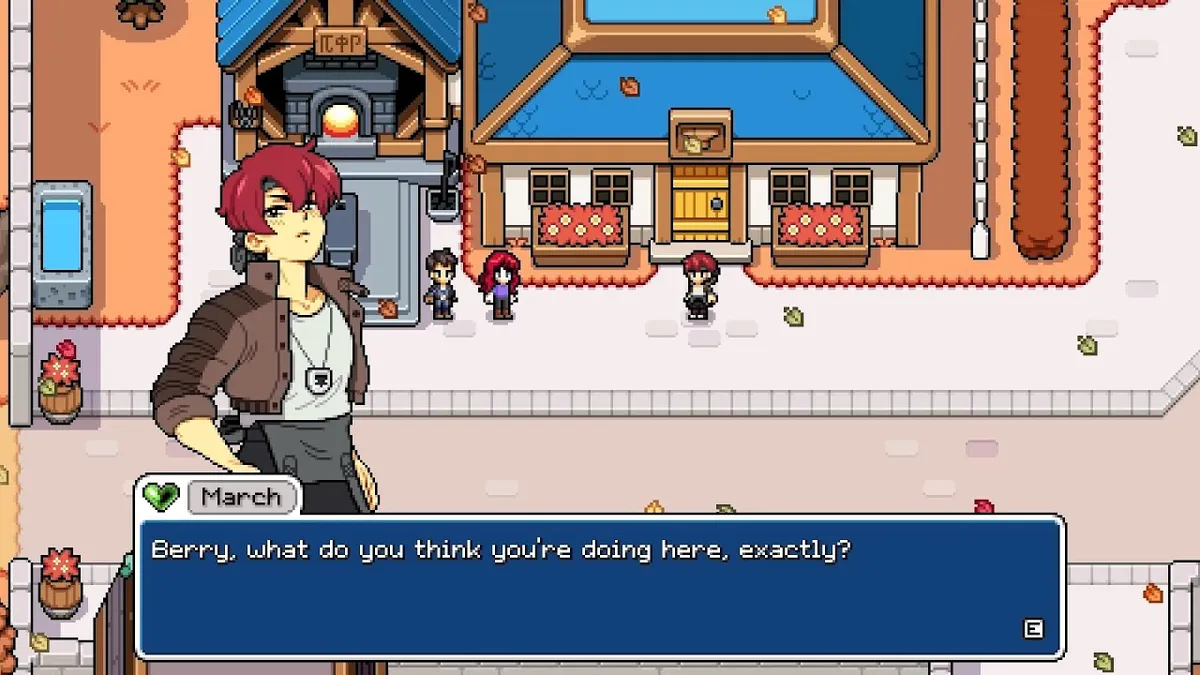
Even the romances, arguably the biggest selling point of the game, don't actually introduce any friction into your idyllic lifestyle. The dates don't take time out of your day. You can date everyone at once but never have to negotiate boundaries or expectations of monogamy and polyamory. You never fight with your partner(s). It's all sweetness without any of the substance. I've said it on my bsky, but I think the reason that March is far and away the most popular romance option is because he is the most friction any of the characters present you with. His affection is slow going, and feels hard won by the time you are able to romance him. But coaxing him out of his shell is a one and done process. Once you're officially dating, he won't ever refuse to go on a date with you or withdraw back into his shell. Mistria only ever reduces friction. It never changes or reimagines it. And the most frictionless parts of life are the ones most easily forgotten.
I sank countless hours into this game the week I learned I'd be losing my job this fall, because I needed comfort food and routine predictability. But that comfort food has long since lost its taste for me, and I think I've had my fill. If I feel compelled to go back to a life or farming sim, I don't think that Mistria is the one I'll choose.
Game Dev Yells Slightly Less At Different Cloud
For comparison's sake, and to show that I'm not being a hater just for the sake of it, I want to bring up Pokopia as well. Pokopia is by no means a perfect game. But insofar both games are about community and rebuilding, both feel very different in their approaches towards their NPCs.
Pokopia takes more of the Animal Crossing approach in that the characters inhabiting the world are archetypal personalities that are mixed and matched with other components; in Animal Crossing, it's their animal species and design preferences. In Pokopia, it's not only their species (because there are no repeated pokemon) but also specific decisions made as a result of their species. Fire type pokemon don't like being rained on. Some cave-dwelling pokemon don't want to be near bright lights. So even if the writing doesn't have the same depth and specificity that Mistria does, the little things add up and ultimately lead to you having to carefully consider the type of home you're building for a pokemon. And the main focus of the game is building homes for your neighbors.
Additionally, you can't craft certain things without asking other pokemon for help. Fire types can help make bricks or smelt ore into ingots; water and grass types help you garden. There is an element of give and take within the community that is a stark contrast to the isolating and frictionless experience of Mistria. No matter how far into Pokopia I get, if I run out of bricks, I will always need to track down Magby and ask it to make me some more. No amount of progression will eliminate that friction, and there is something very special to me when I think about how I'm building a home for a pokemon using the very materials it helped me make.
Sure, you can take the Minecraft approach and just focus on building out your beautiful castle and lava moat or whatever, but the crux of the game's progression hinges on you interacting with and meeting the needs, wants, and expectations of your neighbors. Pokemon will get frustrated and upset if a path isn't wide enough or smooth enough! If you set out a bed for a large pokemon, it needs to be the right size or they can't relax! They need accessibility! I can't think of another life sim where that's considered.
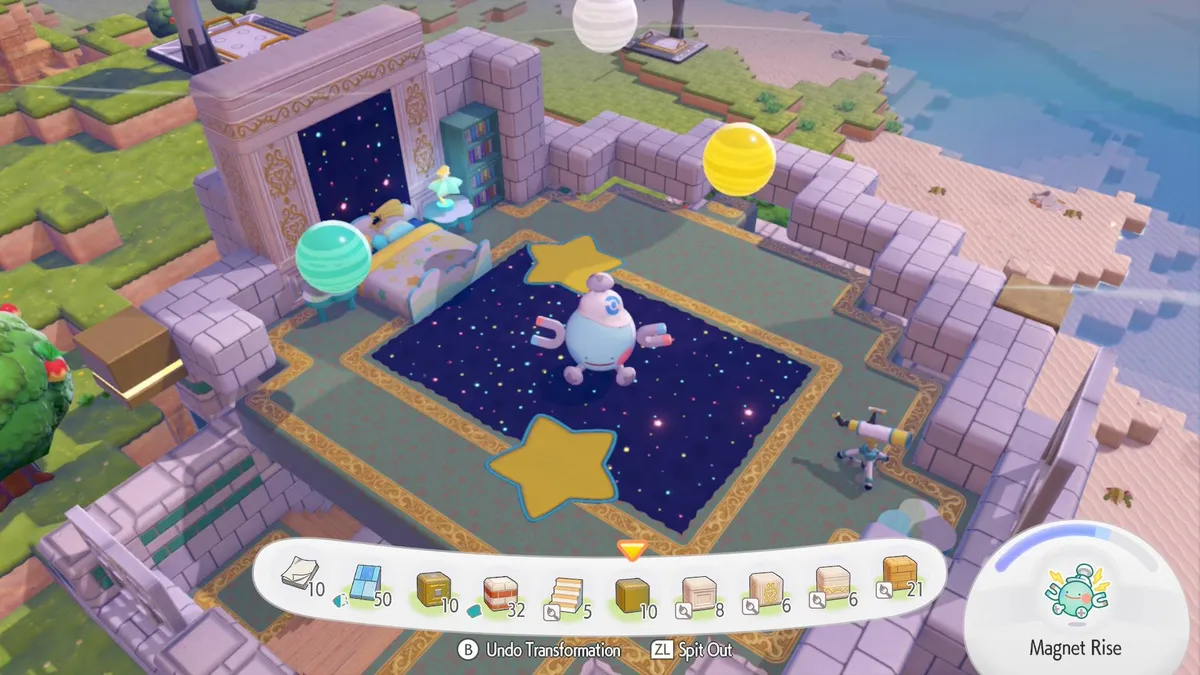
Granted, it IS possible to min-max a pokemon's comfort level, but there is no one-size-fits-all approach to increasing their happiness. They all prefer different things in their habitats, and you cannot progress without meeting at least some of those requirements. Because this is not simply a gifting preference but instead you literally building homes and habitats for them, it feels markedly different from the usual kindness coin relationship structure inherent to life sims. And even if the NPC personalities have a shared dialogue bank that they draw from across species, series veterans like myself are coming in with existing strong feelings for different pokemon. I was over the moon when I saw the Jirachi event. I took it upon myself to build it a little observatory and planetarium, because it's one of my favorite pokemon. There's an element of playing with dolls, of course, but I also am trying to make a beautiful terrarium that I enjoy looking at and my pokemon enjoys living in.
Pokopia is far from perfect. There's an element of controlling and molding your environment that leaves a sour taste in my mouth, and I think the climate change allusions fall flat when there is no real consequence to how the player chooses to shape the world in their image. But it is compelling to me as both a life sim player and as someone who's worked on a life sim for 3+ years. I think comparing Pokopia and Mistria can be a little bit of apples to oranges, especially given that one is a new title in a legacy franchise and the other is an indie game that's been in early access for a while. Neither are completely immune to the inherent extractive nature of simulation games that demand excess and accumulation of resources. But they take steps in new directions that I'm interested in examining, and I think interrogating coziness is an important act in a world that wants us to buy further into our own comfort.
Onion Tax & Life Updates
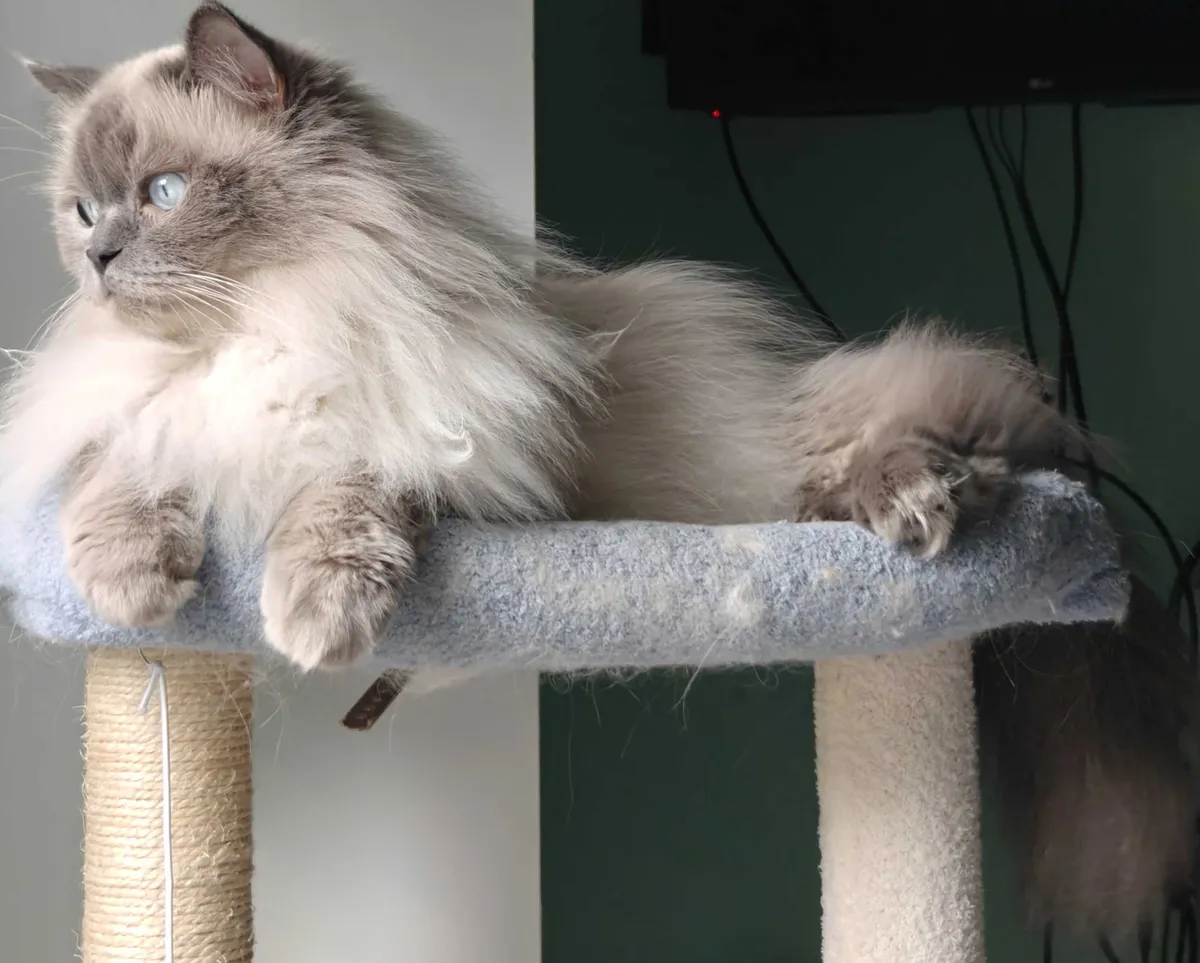
Many thanks for reading this far or congrats on skipping all of that. I've been neglecting to post as much on this blog as I'd like to but in my defense literally everything about my life has changed. I was expecting to move to Montreal earlier this year, and not only was the move delayed, it ultimately changed destinations since the risk of me losing my job was to the point that it felt ill-advised to relocate to a foreign country only to lose my income soon after. So I'm regrouping with family in the D.C. area after a cross-country road trip with my cat, and it's only mildly disorienting to see Onion strut around my childhood home like he owns the place.
I also unfortunately am confirmed to be losing my job at KO_OP in a few weeks due to the funding drought plaguing most of the games industry. There is a chance my remaining coworkers will be able to hire us all back in the spring or so should they sign pitch they're prototyping, but nothing is ever a given in this bitch of an industry. I had the good fortune of knowing in advance that this was a distinct possibility so I could prepare for it, and the additional good fortune of having a healthy relationship with my family. I'm slowly tinkering with a portfolio website for the first time in many years and will eventually start looking more actively for jobs, but for now I am taking advantage of my safety net and focusing on recovery and rest.
I'll be giving a talk at my alma mater later in October that will have me document what it's been like for me as an early career dev to work on a project from start to finish/prototype to launch, so hopefully that will kick my ass into gear for writing blog posts about my work on Young Suns. My website also has me documenting my work and going back into archives for early brainstorming, which is bittersweet in every sense of the word. But c'est la vie, especially in the games industry.